
The Projective Dynamic Logo Framework:
Whatever we may be, from the atoms that form our molecules to our most intimate thoughts, we are nothing but the necessary expression of a simple and implacable logic of coherence. A logic of causality that fulfils itself at every pulse. It is the Origin, the engine and the essence of the universe. The human being is merely its most vulnerable instrument.

The Original Pulse
Towards an Architecture of Logical Necessity
What if reality were not a pre-existing theatre, but the material projection of a logic seeking its own stationarity? In the deepest reaches of our intuition, we sense that the universe is not a mere collection of disparate objects scattered into a void that preceded them. The Projective Dynamic Logo (PDL) gives a formal shape to this intuition: it is a journey upstream, to the conditions under which any persistent distinction can exist at all — before space, time, or matter are assumed. Here, we leave the world of description to enter the world of genesis, where discrete relational structures generate their own substance through the optimisation of coherence on finite signed graphs. Not a stage on which events unfold, but the very act of unfolding — prior to any curtain, prior to any audience.
From Relation to Stationarity
Before the first proton, before the emergence of the slightest particle, PDL assumes only minimal reproducible distinctions: an elementary alternation between two mutually exclusive states, a binary pulsation that can be repeated. In this radical nakedness, no physical law is imposed from the outside; there is no pre-written catalogue of laws of nature, only the requirement that certain relational patterns can close upon themselves without contradiction. Within this framework, existence can be read as a victory of coherence over nothingness: configurations that fail to sustain closure simply cannot persist, whereas those that realise a minimal self-sustaining cycle become candidates for elementary entities. To exist, in this language, is to be the solution to a problem that nothingness cannot solve.
From this analysis emerges a first structural threshold. A detailed combinatorial study shows that no finite signed graph with fewer than four vertices can satisfy the four PDL axioms of binary pulsation, triangular coherence, minimal completeness, and logical optimisation. The first admissible stationary closure is the complete signed graph on four vertices and six edges — the (4,6) structure — which realises a coherent network of triangles together with a global 2-cycle on the edge signs. In PDL, this minimal closure is not postulated to be the electron; rather, the electron at rest is interpreted as the first physical realisation of this logically compelled stationary regime. The theorem precedes the particle.
Within the same framework, more elaborate composite structures motivate the appearance of specific ratios — such as the golden ratio in the architecture of the proton's active surface — where it optimises the partition between internal coherence and surface coupling. Here, the golden ratio is not invoked as a mystical symbol, but as a candidate optimisation factor within a concrete combinatorial model: tightly constrained, mathematically scrutinisable, and open to refutation.
The Compton Frequency: The Pulse of the Logos
Once a minimal closure is established, the structure does not merely exist — it pulsates. The (4,6) configuration supports an intrinsic logical 2-cycle, a stationary regime in which the internal pattern of agreement and disagreement is perpetually re-established at a fixed coherence cost. In this perspective, the Compton frequency of the electron is no longer an arbitrary experimental parameter, but the physical manifestation of this internal pulsation when the (4,6) closure is realised in our universe. The reduced Planck constant can then be re-interpreted as the minimal quantum of action associated with one complete cycle of coherence, so that the familiar relation E = ℏω expresses nothing more — and nothing less — than the cost of continuing to exist.
From this vantage point, what conventional physics calls mass or energy becomes a way of measuring the density of internal coherence cycles, rather than a substance carried by a pre-given background. Matter appears as a pattern of logical closure so coherent that it has acquired stability and inertia. Not a thing in space, but a rhythm that space will eventually have to accommodate.
The Single Thread: From the Infinitesimal to Complex Structures
This impulse is not confined to the subatomic domain. PDL proposes a single relational thread that runs from minimal closures to composite architectures, metrics, and effective fields — without presupposing a continuum spacetime, without borrowing a background.
If the same logic of closure and leakage underlies protons, emergent metrics, and the large-scale structure of the cosmos, then a unified description becomes conceivable in which apparently disparate phenomena share a common combinatorial origin. The same four axioms that select the electron also select the constants, the dynamics, and the geometry.
The Subatomic World
At the microscopic level, the rigour of the primary (4,6) closure finds expression in the electron prototype and in the hierarchical architecture of the proton. Through an optimisation principle applied under explicit constraints, this simple building block self-organises into a composite structure characterised by a finite set of integers: valence occupancies 24 and 28, a valence content rval = 930, a relational sea with 10 087 links, and a total relational budget of 11 017. These numbers are not introduced as empirical fits; they define a minimally complex stationary architecture whose internal consistency can be scrutinised mathematically and confronted with physical constants.
rom this integer architecture, the fine-structure constant and Newton's gravitational constant are each derived — not fitted, not adjusted, but derived — as measures of how internal coherence is distributed between bulk, surface, and leakage into the surrounding relational network; the proton–electron mass ratio follows the same logic as a strongly motivated conjecture, with a residual of a few parts per million left for future refinement. The Schrödinger, Dirac, Born, and Einstein equations follow from the same source, together with the U(1) phase freedom of quantum mechanics. The complete Standard Model gauge group SU(3)×SU(2)×U(1) — colour, weak isospin, and electromagnetism alike — is an unconditional algebraic theorem of the same four axioms, together with the minimal covariant derivative that governs how these symmetries act locally. The Hubble tension dissolves into a density-dependent coupling that was implicit in the proton's structure all along. The periodic table — the valley of nuclear stability for every element from hydrogen to lead — is a corollary of the same four axioms. And the cosmological constant Λ ≈ 1.089 × 10⁻⁵² m⁻² — the rate at which the universe expands — follows as an unconditional theorem of the same logic: the arithmetic product of three prime-power suppressions forced by the non-decomposability axiom C3, spanning fifty-seven orders of magnitude from the combinatorial structure of the proton to the large-scale geometry of space.
Beyond Physics: An Open Horizon
The core PDL corpus is devoted to foundational physics: existence as pulsating closure, particle-like structures, constants, gauge symmetry, emergent metrics and fields, and the interface with the Theory of Objectivity. A structurally distinct extension, the PDL-V programme, applies the same four axioms to hierarchical self-replication and proves, as unconditional theorems, that thresholds separating simple structures, self-replicating structures, and structures capable of representing their own organisation must exist, and must be finite and mutually distinct. It does not yet provide a full-fledged theory of life, evolution, or consciousness — the numerical values of these thresholds remain open, and their biological interpretation is stated explicitly as a conjecture, not a theorem — and the programme is honest about that boundary.
One may tentatively view living systems as structures that internalise and regulate their own coherence budgets in order to resist dissipation — and conscious experience as a regime in which certain closures become capable of representing aspects of their own organisational state. These suggestions are not formal results of the PDL framework, but questions opened by its ontological stance. They are the horizon, not the destination.
An Invitation to Cross the Threshold
The documents collected here and on Zenodo are the rigorous traces of this original pulse: they aim to reconstruct the passage from nothingness to persistent structures with as little arbitrariness as possible. Their mathematical arguments may at first appear austere, but they can be read as scores encoding a discrete harmony between logical constraints and physical phenomena. We invite you to explore these texts — from the emergence of the (4,6) block and the combinatorial proton, through the derivation of the fundamental constants and the four equations of dynamics, to the large-scale resolution of the Hubble tension — not as cold abstractions, but as fragments of a candidate architecture in which reason and intuition can meet.
What follows is not a finished theory, but a living programme — a candidate blueprint for how a logically constrained universe might organise itself from within. If it withstands further mathematical and empirical scrutiny, it would suggest that the universe has meaning not because it mirrors our concepts, but because it realises a remarkably specific structure. One that we are only beginning to read.
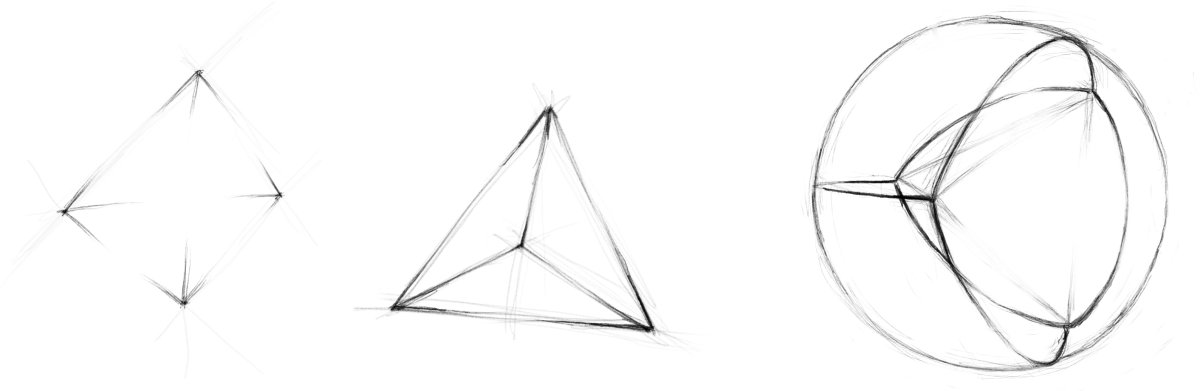
Electron closure sketch
The Listening
Causality in the Mirror of Free Will
"This work did not begin with an equation, but with an act of listening." It was born from a suspicion, a radical intuition: that our basic concepts — space, time, matter — may be weakened echoes of a more fundamental language that we have largely forgotten how to hear. Not because that language is hidden, but because we stopped asking the question it answers. To follow the thread of PDL, one must first learn to be silent: to suspend the certainties of conventional physics and dare a different question — what is the cost of existence when no background, no pre-existing stage, is taken for granted? What remains when everything borrowed is returned?
A Causality of Global Coherence
In classical physics, causality often appears as a prison: an inescapable chain of cause and effect in which every event suffers the yoke of the previous one, reflecting the image of a clockwork universe wound up at the beginning of time. Within the PDL perspective, this picture is not rejected but reframed. Causality is no longer a merely linear sequence imposed from outside; it is the manifestation of a global requirement of coherence on a network of relations. In a world where everything is relation, an event does not simply obey an external law — it realises a pattern of closure that either preserves or disrupts the coherence of the whole.
Constants such as the fine-structure constant cease to be mysterious numbers floating free of any explanation, and become candidates for structural signatures — measures of how coherence is distributed between bulk, surface, and leakage in minimally stable architectures. In this sense, causality can be re-imagined as the way the Logos — the underlying relational order — prevents the parts from contradicting the unity of the whole. Less like the external push of mechanical gears, more like the internal necessity of a musical phrase: each note constrained by all the others, yet the constraint itself is what makes the phrase sing.
The Emergence of Freedom
It is within this absolute rigour that the question of freedom acquires a new profile. If the universe were nothing but blind chance or featureless determinism, free will would appear as a mere illusion — a story we tell ourselves to bear the weight of necessity. But if the universe is a projection of relational logic capable of self-organisation and self-reference, then the human observer need not be treated as an accidental by-product, a ghost haunting a machine it did not build. In that speculative reading, the observer is a closure point — a place where certain relational patterns gain the capacity to represent and evaluate aspects of their own organisation.
Free will, in this view, is not a rupture of physical regularities but a high-level expression of them: the moment where the Logos, after deploying itself through matter, biological complexity, and neural organisation, acquires the capacity to reflect on its own constraints. Freedom becomes the flower growing on the stem of necessity — not despite the stem, but because of it. When we study the 11 017 relations of the proton, we do not simply catalogue the bars of a prison; we begin to learn an alphabet from which more complex forms of organisation — including deliberation, choice, and love — may ultimately arise.
From Logic to the Soul: A Tentative Unity
This act of listening suggests a provocative possibility rather than a finished doctrine: that life, consciousness, and what we call the soul might not be foreign add-ons grafted onto inert matter, but higher-level expressions of the same logic of closure and leakage that underpins the microphysical world. Every choice we make, every act of will, every moment of attention — these can be read as resonances of an underlying projective dynamic, without pretending that PDL already furnishes a complete formal account of psychology or spirituality. The programme is honest about what it has proved and what it has only opened.
We are not merely passive witnesses of the cosmos; we participate in the re-organisation of the relational field through our actions and decisions. The journey proposed here is the chronicle of a thought experiment pushed to its ontological horizon: the speculative recognition that our presence may not be a pure accident, but one possible way in which a logic of coherence tries to become aware of itself. The universe, on this reading, does not merely exist — it listens.
This act of listening does not require a prior command of mathematics or physics. Before the axioms and the graphs, before the derivations and the constants, there is a question — and that question can be followed in plain language. The book Whatever We May Be traces this path from beginning to end: from the stubborn existence of an electron to the fragility of the human condition, without presupposing anything beyond the willingness to think carefully. It is the threshold before the threshold — the place where the intuition of PDL can be met on its own terms, before the formal architecture takes over.
DN | Popular introduction to the PDL framework in book form, addressed to a dual audience from secondary school to research level. Traces the guiding thread from the minimal (4,6) closure and the combinatorial proton to coherence leakage, fundamental constants, and the human condition, without presupposing prior knowledge of the technical corpus. Primary accessible entry point to the programme.
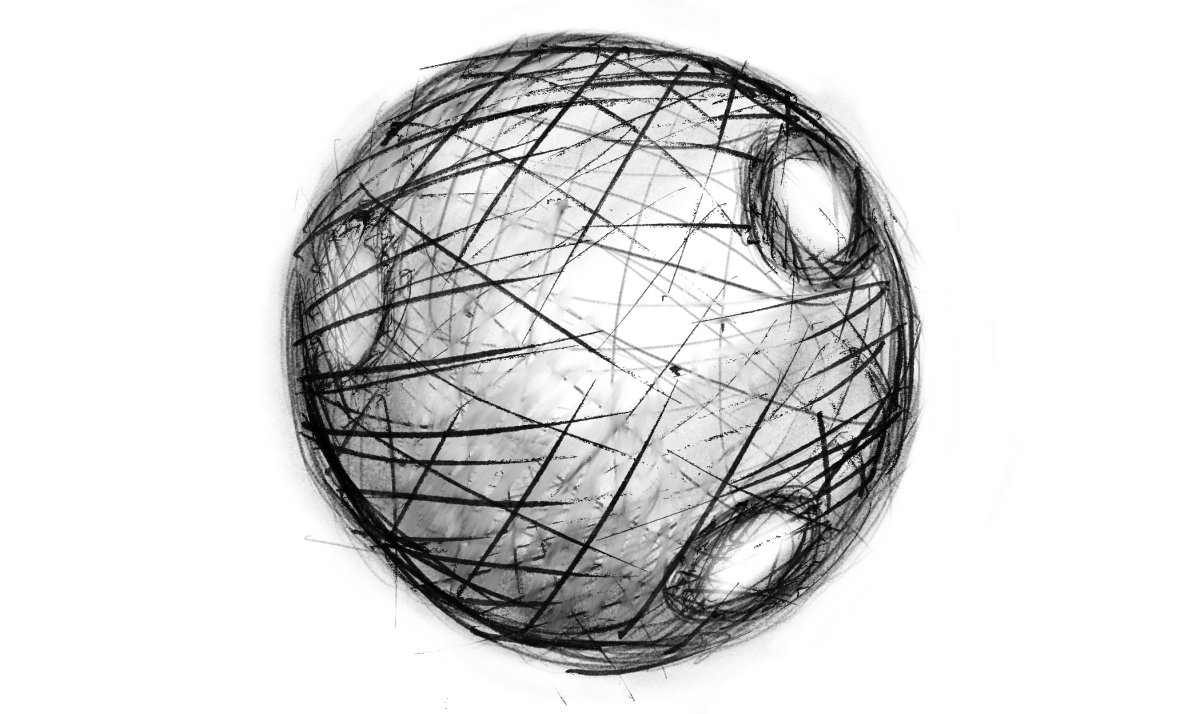
Proton sketch
D1 | The Emergence of Physical Reality within the Framework of the Projective Dynamic Logo (PDL). Core axioms, (4,6) block, proton architecture, constants, gravitation, cosmology.
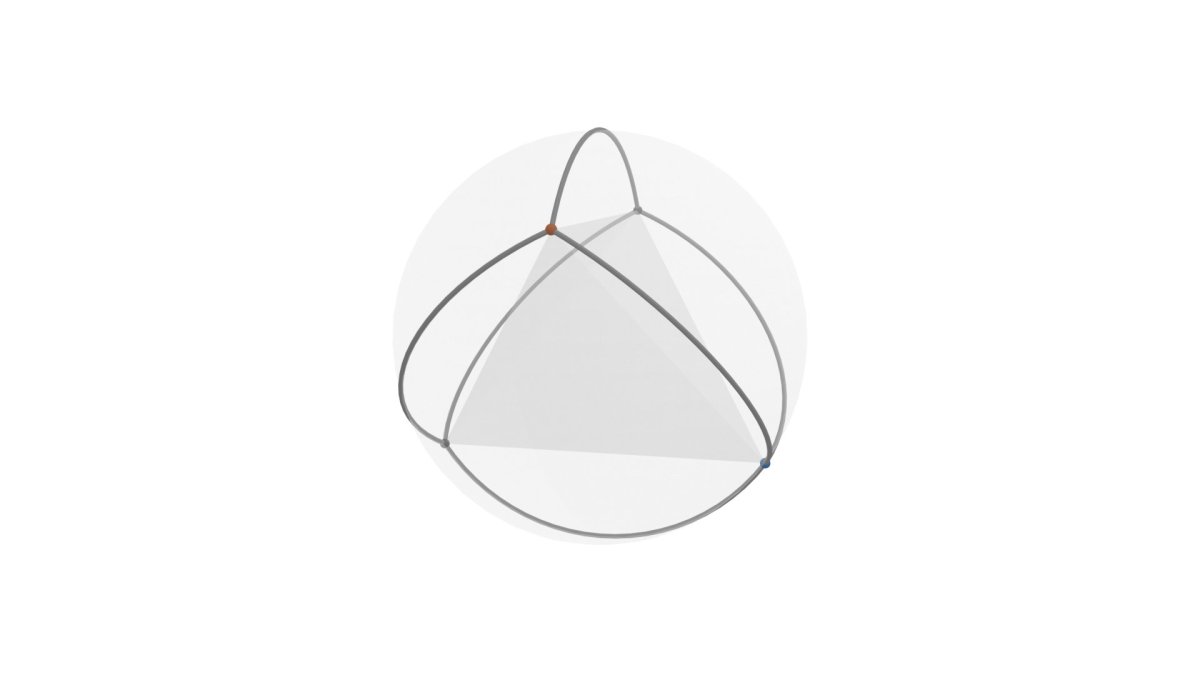
Electron 3D simulation
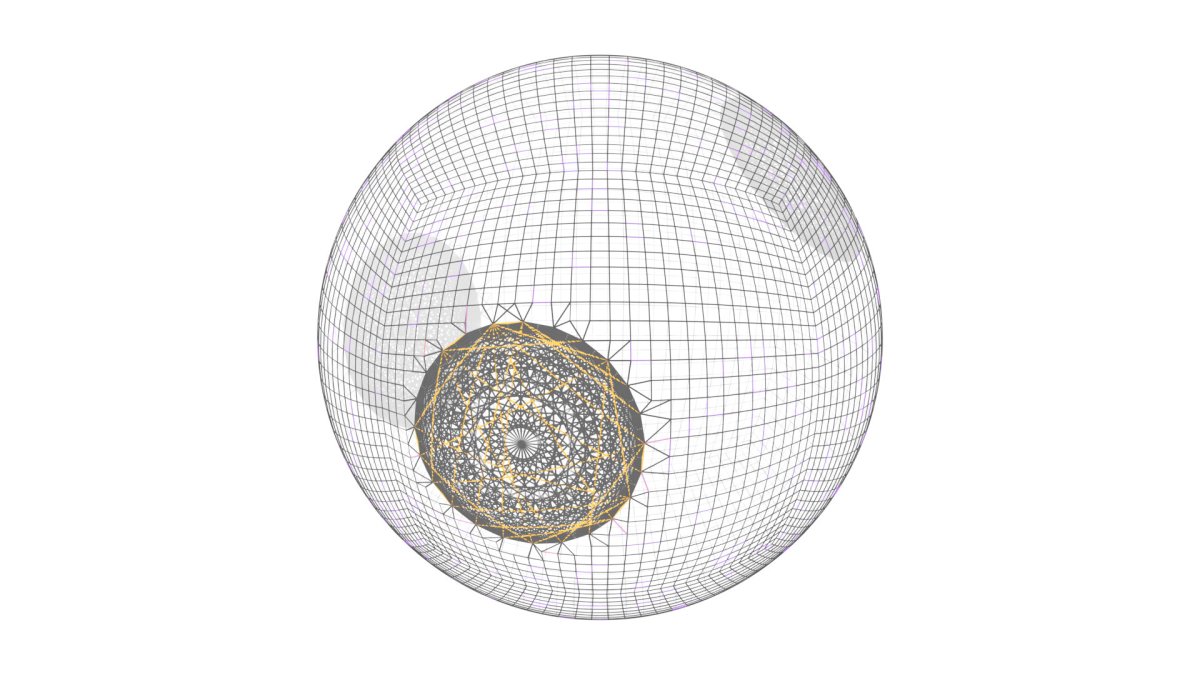
Proton 3D simulation
The Weave
One fabric, three regimes — and what still separates a picture from a proof.
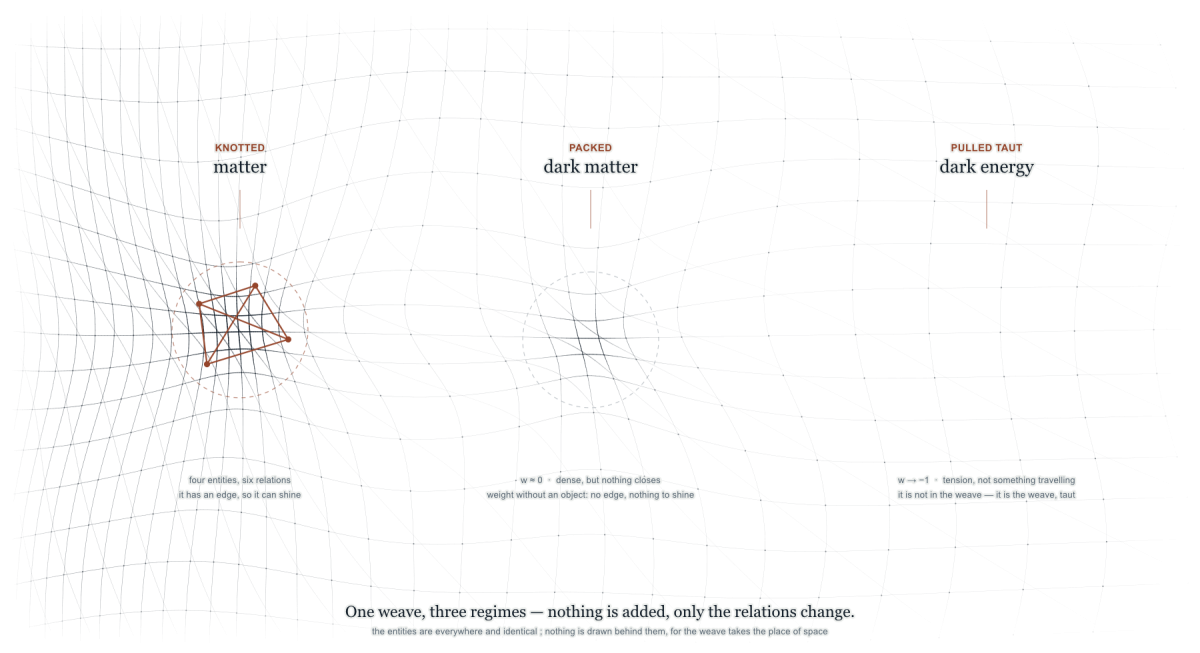
What the Image Shows There is no background in this image, and that absence is the first thing to notice. No grid, no frame, no stage on which the pattern has been laid. The weave is not drawn in space; it is drawn instead of space. In the PDL framework, a configuration is a finite signed graph: a set of entities and the signed relations that hold between them. Nothing else is given, and nothing else is needed. Space, distance, and duration are not the container of this structure — they are what the structure eventually amounts to. The points scattered across the image are those entities. They are identical, and deliberately so. An entity in PDL carries no property of its own: no mass, no charge, no position, no name. The automorphism group of the minimal closure is the full symmetric group on four letters — its four vertices are entirely interchangeable. What distinguishes one entity from another is nothing but the pattern of relations in which it stands. In the image, the entities are therefore drawn everywhere at the same size and the same weight. Only their spacing changes, because the relations holding them change. That is the single variable in this picture. Every line's thickness and opacity is computed from the local compression of the weave, not chosen by hand. Where the relational content per volume rises, the lines darken and thicken. Where it thins, they fade. The density you see is the density. Knotted: Matter On the left, the weave has closed upon itself. Four entities, six relations, drawn in red: this is the minimal admissible closure of the four axioms — the (4,6) block, the electron prototype. It is not a region of the fabric that happens to be dense. It is a loop that returns to itself, sustains a binary pulsation, and possesses a boundary. The boundary is the decisive feature. A closure has an active surface, and it is across that surface that coupling to the rest of the network occurs — which is why matter can absorb and emit light, bind chemically, and be seen at all. A closure is a thing: it can be counted, it persists as an individual, it has an edge that can vibrate. Packed: The Dark-Matter Reading The dashed circle on the left and the dashed circle in the middle have exactly the same radius, and the weave inside them has comparable density. This pairing is the argument of the image. In the middle circle, the entities are just as numerous and just as tightly held — and nothing has closed. There is no loop, no boundary, no individual. Relational density carries weight regardless of whether it closes. What it cannot do, absent a boundary, is radiate: there is no active surface for electromagnetic coupling to act across. On this reading, what astronomy attributes to invisible particles would be weight without an object — not a new kind of matter, but the same fabric in an unclosed regime. This is a reading, and it is important to say so plainly. The corpus establishes the equation of state of the coherence fluid as a theorem: the mass, spin, and orbital components each vanish exactly, which is the equation of state of cold dark matter. What is not established is the identification itself — that the integrated coherence content accounts for the observed abundance, clusters as observed, and lenses light as observed. That is recorded in the corpus as an open problem, not as a result.
Knotted: Matter On the left, the weave has closed upon itself. Four entities, six relations, drawn in red: this is the minimal admissible closure of the four axioms — the (4,6) block, the electron prototype. It is not a region of the fabric that happens to be dense. It is a loop that returns to itself, sustains a binary pulsation, and possesses a boundary. The boundary is the decisive feature. A closure has an active surface, and it is across that surface that coupling to the rest of the network occurs — which is why matter can absorb and emit light, bind chemically, and be seen at all. A closure is a thing: it can be counted, it persists as an individual, it has an edge that can vibrate.
Packed: The Dark-Matter Reading The dashed circle on the left and the dashed circle in the middle have exactly the same radius, and the weave inside them has comparable density. This pairing is the argument of the image. In the middle circle, the entities are just as numerous and just as tightly held — and nothing has closed. There is no loop, no boundary, no individual. Relational density carries weight regardless of whether it closes. What it cannot do, absent a boundary, is radiate: there is no active surface for electromagnetic coupling to act across. On this reading, what astronomy attributes to invisible particles would be weight without an object — not a new kind of matter, but the same fabric in an unclosed regime. This is a reading, and it is important to say so plainly. The corpus establishes the equation of state of the coherence fluid as a theorem: the mass, spin, and orbital components each vanish exactly, which is the equation of state of cold dark matter. What is not established is the identification itself — that the integrated coherence content accounts for the observed abundance, clusters as observed, and lenses light as observed. That is recorded in the corpus as an open problem, not as a result.
Pulled Taut: Dark Energy Towards the right, the weave is stretched. Relations thin out, and what remains is tension. A tension pulls outward — and this is where the same fabric ceases to behave as weight and begins to behave as expansion. The corpus derives this as an unconditional theorem of the four axioms: the leakage component of the coherence fluid has an equation-of-state parameter of exactly minus one, the signature of a cosmological constant. The resulting density fraction agrees with the Planck 2020 value to 0.17 per cent, with no cosmological parameter used as input. The theorem is unconditional; the numerical agreement passes through the coupling κ and is therefore conditional on the named hypothesis Hφ, as recorded in the current global mapping. Dark energy, in this picture, is not something travelling through the weave. Energy travels: it is the cost of a pulsation, it passes between closures, it is stored and spent. Dark energy does none of that. It is not in the fabric — it is the fabric, taut. What the Image Does Not Say The closure drawn here is the minimal one, four entities and six relations. It stands for the electron, not for matter in general: a proton is a hierarchical closure carrying a total relational content of 11 017, far beyond what any figure at this scale could render honestly. And the image proves nothing. It illustrates an ontological stance — that matter, dark matter, and dark energy might be one fabric in three regimes rather than three substances — of which one part is a theorem, one part is a hypothesis carried explicitly, and one part remains an open problem. The distinction is the whole discipline of this programme, and it is not softened here.
The Threshold
The Archives of a Foundational Programme
"The maps of the Logos: when structure becomes destiny." If this resonance finds an echo within you, the true exploration begins where words fade and the rigour of structure takes over. The documents gathered here are not mere technical reports or isolated academic speculations; they are the formal tracings of a world explored from the absolute nakedness of logic. They constitute the archives of a foundational programme in which each construction is a boundary crossed, each proof a territory won back from the fog of assumption, and each constant a bridge — not postulated, but derived — toward a deeper unification.
The Unification of Scales: A Single Thread
In these pages, you will encounter an architectural framework that seeks to close the gap between the subatomic and the cosmological — not by adding new fields or particles, but by showing that the gap was never as wide as it appeared. PDL proposes a candidate relational substrate beneath familiar formalisms. Within this perspective, gravitation is no longer treated as a mysterious force acting at a distance, but as the metric-level expression of minimal coherence leakage from composite nucleonic structures into a surrounding relational network.
From the primary (4,6) closure to the combinatorial proton architecture and the emergent metric, each step illustrates how much can be reconstructed from a small set of axioms on finite signed graphs — without invoking ad hoc particles or unconstrained fine-tuning. Newton's gravitational constant is fixed by this combinatorics to 27 parts per million, its numerical value resting on an independently established geometric leakage parameter; one specific combinatorial link further down that chain — the hierarchical filter factor — was found in 2026 to rest on a flawed derivation and was honestly retracted by its own author, reopening a single, well-delimited problem without altering the constant's established value. The Schrödinger, Dirac, Born, and Einstein equations have been derived, not assumed — and the U(1) phase freedom of quantum mechanics is not a postulate but a structural consequence of the K₄ pulsation. The periodic table, from hydrogen to lead, is a corollary of the same four axioms. The Hubble tension dissolves not into a new free parameter, but into the density-dependence of a coupling that was always there, waiting to be read off the proton's integer architecture. The London equation, the Bekenstein–Hawking coefficient 1/4, and the cosmological constant Λ ≈ 1.089 × 10⁻⁵² m⁻² are all unconditional theorems of the same four axioms. The causal chain from combinatorial logic to the rate of expansion of the universe — spanning 57 orders of magnitude — is complete.
The Heat Behind the Crystal
Do not be intimidated by the surgical precision of the demonstrations. The apparent coldness of mathematics here is that of a crystal, not of a void. Every crystal began as a liquid — disordered, searching, alive with possibility. The rigour you will find in these documents is not a closing of doors but an opening: each proof that narrows the space of possibilities simultaneously illuminates what remains, and it is in that remaining space that the truly interesting questions live.
Behind each derivation — from the global mapping of the programme, through the structural bridge between α and G, to the Gleason uniqueness of Born's rule and the derivation of U(1) phase freedom from the K₄ pulsation — beats the intuition of a living, coherent, and ultimately intelligible universe. These works are attempts to address a familiar paradox: how necessity, structure, and meaning can coexist in a single world. They suggest that strict logical constraints need not be the enemies of richness or life, but may instead provide the cradle within which complexity can unfold. From this vantage point, biological evolution and the awakening of consciousness can be contemplated as possible higher-order expressions of the same logic of closure and leakage — not as results already derived by PDL, but as horizons opened by its ontological stance.
Life, in this light, can be pictured as logic that has learned to preserve and reorganise itself. Memory as coherence that endures long enough to be shared. And thought — perhaps — as a closure that has become capable of reflecting on its own conditions of existence.
The Invitation
You are invited to cross this threshold at your own pace. Whether you are guided by philosophical curiosity, by the rigour of theoretical physics, or by a quieter search for meaning, you are not a stranger to the system you are studying. By engaging with these texts, you become one of the points at which relational structures are reflected upon, questioned, and possibly reshaped.
Here, the time for narrative gives way to the time for argument. Enter the PDL corpus and examine for yourself how far four axioms on finite signed graphs can go — from the electron's first pulse, through the architecture of the proton, to the large-scale structure of the universe, and back again to the fragile coherence of a human life.
Welcome home, if this way of thinking resonates with you.
The Crossing
Entering the PDL Archive
If you have not yet read Whatever We May Be, it remains available as a companion at any stage of this journey — a way back into plain language whenever the formal structure calls for it. There is no shame in returning to the threshold; sometimes the clearest path forward runs through the words that first made the question feel necessary. Beyond narrative and intuition, a different kind of journey begins — one traced in axioms, finite graphs, and carefully established proofs.
The PDL corpus gathered here forms the working archive of a foundational research programme: from the minimal (4,6) closure and the combinatorial proton, through the structural derivation of the fundamental constants, to the Schrödinger, Dirac, Born, and Einstein equations derived from four axioms alone. Newton's gravitational constant is fixed at 27 ppm from an independently established leakage parameter. The Hubble tension is now a structural consequence. The U(1) phase freedom of quantum mechanics — the invisible symmetry that underpins all of quantum theory — is not a postulate but a theorem of the K₄ pulsation. The periodic table, from hydrogen to lead, is a corollary of the same four axioms.
The deepest foundational question — whether the axioms themselves are enough to establish that a closure must treat all its own relations with perfect symmetry — was the last great open problem of the programme's axiomatic core. It has been answered: the Equiparticipation Lemma establishes that indifference — the impossibility of preference without a reason — is a logical necessity, following unconditionally from axioms C1–C4 alone. A separate, more specific problem in the same causal chain — the exact combinatorial derivation of the hierarchical filter factor — was reopened in 2026 after its proposed proof was found, on independent re-verification, to contain an arithmetic error; it is documented honestly as an open problem, without affecting the established numerical value of Newton's constant.
New frontiers have opened beyond this foundational core. The explicit form of the coherence stress-energy tensor Ccoh — all four of its components — is derived as an unconditional theorem, and its full synthesis together with the emergent metric is now consolidated in a single reference document. The London equation, connecting the orbital coherence current to the U(1) phase structure, is proved from axioms C1–C4 alone. The coefficient 1/4 of the Bekenstein–Hawking formula is derived as the stable fraction per surface relation. And the cosmological constant Λ ≈ 1.089 × 10⁻⁵² m⁻² follows as an unconditional consequence of four axioms, without fine-tuning and without free parameter: it is the arithmetic product of three prime-power suppressions forced by the non-decomposability axiom C3. The causal chain from axioms to the rate of expansion of the universe — spanning 57 orders of magnitude — is complete.
The electroweak frontier, once open, is now closed: the Weinberg angle θW = 19π/119 is derived from axioms C1–C4 alone, without any Standard Model input, and the SU(2) gauge structure follows as an unconditional theorem from axioms C1 and C2 alone. The SU(3) colour symmetry, together with its physical action on quarks in the fundamental representation, is derived with the same rigour, and the minimal covariant derivative Dμ = ∂μ − igAμ is shown to be the unique gauge-transport structure compatible with the axioms — not a postulate borrowed from field theory, but a survival condition of coherence itself. The complete Standard Model gauge group SU(3)×SU(2)×U(1) is, as of this writing, an unconditional theorem of four combinatorial axioms on signed graphs. The ratio of the Z and W boson masses follows the same rigour as a further unconditional theorem; their absolute scale, the Higgs mass, and the full spectrum of quark masses are addressed by strongly motivated conjectures, each verified numerically without a free parameter beyond the single external isospin-breaking input Δmiso.
Beyond this gauge closure, the programme has returned to its oldest unresolved frontier — gravitation at the horizon of a black hole — and confronted it with the proton's own surface theorem: a structural, not literal, correspondence with the soft-hair programme of black hole physics is proposed and honestly qualified by a large negative result, while a companion study proves that PDL forces exactly two coherence defects on any closed spherical surface — offering a structural account of why no black hole has ever been observed without spin — together with a nucleon dissolution threshold that coincides, without being tuned to do so, with the mass gap observed in compact astrophysical objects. A dedicated search for a fifth axiom candidate — a genuine logical metric, still missing from the framework after everything else derived here — has produced a first theorem on the geometry of the electron closure itself, alongside an extensive, honestly documented family of negative results. And a collaboration with an independently developed relational framework (OFN) has identified several precise mathematical correspondences — some proved as identities, others candidly labelled as candidate echoes awaiting further evidence — around the shared question of why there are exactly three generations of fermions.
You are invited to explore these documents at your own pace and from your own background — not as spectators of a finished theory, but as participants in an ongoing attempt to understand how far a simple logic of closure and coherence can illuminate the world. The foundational core is sealed, the gauge sector is derived, and several genuinely open problems remain at the frontier: the macroscopic entropy of a black hole counted directly from combinatorics, a relational derivation of the speed of light itself, the numerical thresholds of the PDL-V programme's life and consciousness conjecture, and the deeper meaning — if any — of the correspondences uncovered with the OFN framework. Nothing here is presented as finished. Everything here is presented as checked, and as still being checked. The next proof has not yet been written; that is precisely the invitation.

A Guided Journey
Phase I — The Awakening (Logical Foundations)
How "nothing" becomes a persistent distinction.
- DN | Whatever We May Be — The Projective Dynamic Logo
Narrative entry point requiring no prior knowledge. Traces the guiding thread from the question of persistence, through the minimal (4,6) closure and the combinatorial proton, to coherence leakage, fundamental constants, and the human condition. Recommended first reading for any newcomer. - DM | PDL: Global Mapping of Structures, Results, and Open Problems (version 34)
Authoritative meta-level guide: complete corpus table (D01–D69) plus joint bridge notes N01 and N02, D19ad and DL03, two logical dependency maps (foundational chain and gauge sector), all completed layers, and the causal chain C1–C4 → Dμ. Version 34 is the first version of this document to withdraw a standing claim of unconditional causal closure. Two independent gaps are now recorded on the chain from the axioms to Newton's constant: the active surface Rsurf = φ·rval/3 is reclassified from theorem to named hypothesis (Hφ), following an audit of D05 that found four errors in version 1 of that document; and OP-B is reopened by D44v2, both filter-product constructions for the hierarchical factor k having failed arithmetic verification. Neither correction introduces an adjustable parameter: φ is a fixed algebraic number and the factor 1/3 counts the three valence cores, so the statement that the programme carries no free parameter beyond Δmiso survives literally. Three sections are new — the active surface and Hφ, the sea counting rule, and D68/D69 — together with three new epistemic layers, nine open problems introduced or reopened, and a new falsifiable prediction (P20) that provides a route to refuting Hφ. The quintuplets, Δn = 4, Ebord, εgeom and the gauge chain D57–D61 do not pass through Rsurf or k and are unaffected. Version 33 added D19ad, a philosophical addendum to D19, and DL03, extending DL01/DL02 with the electron's alphabet as a maximum-distance error-correcting code.
- D02 | Introduction to the Projective Dynamic Logo (PDL)
Conceptual entry point: motivation, "reality as logical closure", first encounter with the (4,6) block, the proton architecture, and key constant relations.
- D01 | The Emergence of Physical Reality within the Framework of the PDL
Core founding text: axioms on signed graphs, definition of closures, emergence of the (4,6) block, proton architecture, fundamental constants, and first steps towards gravitation.
- D16a | Minimal Stationary Closures in PDL: Necessity of the (4,6) Block
For readers wanting the full proof: no finite signed graph on ≤3 vertices satisfies all four PDL axioms; the (4,6) configuration on four vertices is the unique first admissible elementary closure. - D19 | Existence as Pulsating Closure: An Ontological Meditation on PDL
Philosophically oriented reflection on what it means, in the PDL language, for something to exist as a self-sustaining pulsating closure. - D19ad | On the Necessity of the Binary Distinction and the Dissolution of the Bearer Problem: An Addendum to D19
Closes two gaps left open in D19: derives the binary cardinality of the minimal distinction from the nature of a single, undecomposed act of distinguishing, rather than asserting it directly, and names and dissolves the "bearer problem" silently presupposed by the trace-to-memory argument, by denying the reality of a discrete instant prior to the first distinction. - D20 | Whoever We May Be: Existence, Coherence, and Vulnerable Instruments
Philosophical synthesis connecting minimal closures, coherence leakage, and emergent metrics to causality, freedom, transcendence, and human vulnerability.
Phase II — The Architecture of Matter (Atomic Blueprint)
How dense relational patterns stabilise matter.
- D16 | On the Combinatorial Selection of the Proton Architecture in PDL
Combinatorial analysis of the proton architecture: integer constraints, selection functional, quintuplet (24, 28, 930, 10087, 11017), competing candidate architectures. Note on notation: 24 and 28 count the entities of a single up-type and down-type valence core respectively; the proton carries two up cores and one down core, so that rval = 2·C(24,2) + C(28,2) = 930 and the mean coherence core per valence quark is rval/3 = 310.
- D22 | Nuclear Stability and the Periodic Table as Combinatorial Closure Hierarchies in PDL
First derivation of the neutron quintuplet from the proton architecture. The asymmetry Δn = nd − nu = 4 is the structural source of nuclear spin-orbit coupling. Maximum magic number N = 126 without free parameters. One erratum recorded in D68.
- D40 | Nuclear Stability and the Periodic Table from PDL Combinatorial Axioms
Derives the architecture of nuclear stability from the proton and neutron quintuplets alone. Saturation threshold Zsat ≈ 20 (calcium). Eight assembly rules governing nuclear construction from hydrogen to lead. Its filling-rate table is vindicated by the D47 audit: 74–88% of the valley of stability reproduced under the corrected reconstruction formula.
- D47 | OP14 Reopened: The Filling-Rate Table of D40 Vindicated, an Equation Error Corrected, and the Simplified Rule of D47v1 Refuted
Version 2. OP13 remains resolved: Δn = 4 is the unique value for which the discriminant equals 1492 (a perfect square), forcing s = 1/12 unconditionally, and all seven nuclear magic numbers {2,8,20,28,50,82,126} are independently re-verified. OP14 is reopened: D47v1's two-valued filling-rate rule, previously reported as an unconditional theorem, reproduces none of 31 experimental sub-shell boundaries once a missing factor of 2 in the reconstruction equation is corrected. D40's original table is vindicated under the corrected formula.
- D41 | Structural Closure Multiplicity and the Island of Inversion: PDL Analysis of 84,86Mo
First confrontation of the PDL nuclear framework with a published nuclear spectroscopy experiment. Two falsifiable predictions for 88Ru/90Ru and 92Pd/94Pd, testable at FRIB and RIKEN.
- D56 | Derivation of the Linear Scaling Ncomp(k) = k from Axioms C1–C4 — Resolution of OP-D41-1-A
Resolves OP-D41-1-A. Theorem: Ncomp(k) = k exactly for a k-particle–k-hole nucleus at the boundary of an island of inversion, proved via three lemmas (D16a, D29, axiom C3). Corollary: Rsurf(k) = k·T. Experimental motivation: Ha et al. (Nature Communications 2025) and Escudeiro, Recchia, Lenzi et al. (Phys. Rev. C 2026).
- D05 | A Minimal Relational Sketch for the Emergence of the Golden Ratio in PDL (version 2 — corrected)
Version 2 corrects four errors present in version 1, two of which together produced a conclusion numerically incompatible with the formula this note is cited to justify: taken at face value, version 1 yields Rsurf = 574.772 and α−1 = 179.921 against a measured 137.036. The corrected self-similarity condition — the role of the active surface with respect to the whole mirrors the role of the core with respect to the surface — reproduces Rsurf(p) = 310φ exactly, with Rcore = rval/3 = 310. The central claim of this version is stated negatively and explicitly: Rsurf = φ·rval/3 is not derived from axioms C1–C4. It is a named hypothesis, Hφ, and κ, α, σ(N), Geff, the Hubble prediction and Λ are conditional upon it. Rsurf is an expectation under the uniform measure of D42, not a cardinality: an irrational cannot be the size of a set, and no integer reproduces the fine-structure constant. This version supersedes the epistemic labels attributed to D05 in D39 and D43, which recorded its content as a theorem.
Phase III — The Constants (Scales of Being)
Why the constants take the values they do.
- D12 | A Structural Derivation of the Fine-Structure Constant from PDL
Closed-form expression for α in terms of the proton–electron mass ratio, rval = 930, and the golden ratio; relative accuracy ~10−4, no free parameters. The derivation runs through the active surface and is therefore conditional on hypothesis Hφ (D05 v2, DM v34) — a structural hypothesis, not an adjustable parameter.
- D23 | Topological Origin of the Exponent 18: K4, S2, and the Periodic Table
Theorem: the exponent 18 in Geff ~ ε18 is a topological necessity. K4 ≅ S2 imposes exactly the decomposition 18 = 6+5+4+3. - D21 | Universal Coherence Leakage: A Structural Bridge between G and α (Version 3)
GPDL = 6.67448 × 10⁻¹¹ m3 kg−1 s−2 at 27 ppm from CODATA 2022, no free parameters.
- D25 | A Parameter-Free Structural Bridge between α and Newton's Gravitational Constant
Definitive form of the α–G bridge: εG = 0.0075194, G at 27 ppm. Primary reference for the structural connection between the two fundamental constants. The bridge passes through the active surface and is conditional on Hφ (D05 v2); no adjustable parameter is introduced.
Phase IV — The Three Gates (Critical Proofs)
How Newton's constant is derived, and what remains conditional.
- D29 | Axiomatic Derivation of 155/11017 — Gate 1 Resolved
Theorem: 155/11017 proved from C1–C4 alone, verified exhaustively over all 768 admissible configurations.
- D30 | Structural Derivation of the QCD Correction Coefficient — Gate 2 Resolved
Theorem: coefficient a = 2 structurally forced by axiom C1. Δmiso is the unique irreducible external parameter.
- D36 | Proof of Geff(N) = σ(N)·GPDL from the Trace Structure of K4
Theorem: density-dependent gravitational coupling proved from the trace structure of K4. The independence of gravitational engagements (σ0 = 0 exactly) and the tracelessness Tr(A) = 0 follow from the combinatorial structure alone. The functional form of σ(N) is unconditional; its argument κ depends on hypothesis Hφ, so Gate 3 holds under Hφ rather than, as stated up to DM v33, without any named hypothesis.
- D42 | Derivation of H3 from C1–C4: The Equiparticipation Lemma and the Closure of Causality
Resolves OP1: H3, the Indifference Lemma, is an unconditional theorem of C1–C4, proved via three lemmas establishing that the uniform measure on Rtot is unique. The corollary κ = 310φ/11017 ∈ ℚ(√5) follows once Rsurf is given — and Rsurf is the named hypothesis Hφ (D05 v2). OP1 is correctly resolved; it was never on its own sufficient to close the chain.
Phase V — The Derived Equations (The Dynamics)
Schrödinger, Dirac, Born, Einstein, U(1), the Weinberg angle, SU(2), SU(3), the fundamental representation 3 of SU(3)c, the minimal covariant derivative Dμ, gauge boson masses, and the quark mass spectrum from four axioms. This sector does not pass through the active surface and is unaffected by hypothesis Hφ.
- D32 | Schrödinger Dynamics from the (A)∧(B) Coupling Criterion in PDL
Theorem: the Schrödinger equation is derived — not postulated — from the (A)∧(B) coupling criterion applied to K4 pulsation dynamics.
- D33 | Dirac Equation from the SL(2,ℂ) Pulsation of K4 in PDL
Theorem: unique admissible time-reversal operator T = −iτ2, forcing spin-½ statistics and SU(2) structure.
- D34 | Born Rule from (A)∧(B)-Admissible Amplitudes in PDL
Theorem (Level 1): five Gleason axioms verified, forcing Born's rule uniquely. Level 2 completed in D46.
- D46 | Born's Rule Level 2: Derivation of U(1) Phase Freedom from the K4 Pulsation in PDL
Resolves OP4. The U(1) phase freedom ψ ↦ eiαψ is a structural consequence of K4 pulsation via the Hopf fibration S1 → S3 → S2. Two errata recorded in D68, together with a divergence between D46's and D68's definitions of the pulsation (open problem OP-D68-7).
- D35 | Quantitative Einstein Equation from Geff(N) = σ(N)·GPDL in PDL
Theorem: κPDL(N) = σ(N)·κNewton. Hubble tension reproduced at 0.006%, zero free parameters. Conditional on Hφ through κ (D05 v2, DM v34).
- D57 | Derivation of the Tree-Level Weinberg Angle and the SU(2) Gauge Structure from the PDL Axioms C1–C4
Theorem: sin2θW(tree) = sin2(π/Re) = 1/4, via two independent routes equivalent via |V4| = 4. Hypothesis HSU2 introduced here; proved as unconditional theorem in D60. New result: A4/V4 ≅ ℤ3 identified as the combinatorial origin of β1(K4) = 3.
- D60 | From the Logic of Existence to the Gauge Symmetry Group: A Proof of Hypothesis HSU2 from Axioms C1 and C2
Resolves OP-D57-1. Theorem: HSU2 is an unconditional theorem of C1+C2 alone. The co-originarity of the two pulsation states forces V4-invariance; s → −s breaks C2; Geff = S4/V4 ≅ S3. No conjectural step remains in the gauge group sector. Includes two verification scripts (PDL_C1V4_script1.py, PDL_C1V4_script2.py).
- D58 | Derivation of the SU(3) Gauge Structure from the PDL Axioms C1–C4: Completion of the Standard Model Gauge Group
Theorem (algebraic): SU(3) from C1–C4 + Cartan–Killing–Weyl, via five lemmas on the automorphism group S4 of K4. Corollary: SU(3) × SU(2) × U(1) is an unconditional algebraic theorem of C1–C4.
- D59 | Physical Identification of SU(3)c and the Fundamental Representation 3 from the PDL Axioms C1–C4
Theorem: SU(3)c acts on the trace-zero plane W = {(a,b,c) ∈ ℂ3 : a+b+c = 0} in the fundamental representation 3. Axes of W canonically labelled by V4{e}. The orientation selecting 3 over 3̄ is forced by Δn = nd − nu = 4 > 0 (D47). Exact identity: k3/(k1+k2) = Re = 6.
- D61 | Gauge Dynamics as a C4 Survival Theorem: Derivation of the Minimal Covariant Derivative from the PDL Axioms C1–C4
Resolves OP-D59-2. Theorem: Dμ = ∂μ − igAμ is the unique gauge-transport structure compatible with C4. Coh(K4) ≅ ℤ23 (2048 exhaustive checks); V4 acts faithfully on this group (288 checks); consistency with Ggauge; Utiyama's uniqueness theorem identifies Dμ. The causal chain C1–C4 → Dμ is closed. Includes two verification scripts.
- D62 | Gauge Boson Masses from Combinatorial Axioms: Derivation of v, MZ, MW and Prediction of MH
First derivation of the electroweak boson masses from the coherence network Coh(K4) ≅ ℤ23. Theorem: MZ/MW = 1/cos(19π/119) (unconditional, from D55+D57); four primary Higgs decompositions in ℤ23 (unconditional); neutrinos exit the cascade at level 2 with Rsurf(ν) ≈ 0 (unconditional). Conjecture T1: v = Ntot2/(Re·k1)·mp = 14161/54·mp [676 ppm PDG]. Conjecture: MZ/mp = 97.179 via analytical chain Δα(MZ) [84.6 ppm, 3.67σ]. Conjecture: MH/mp = 133.611 [1.49σ]. Resolves OP10-c (W/Z ratio) at the structural level. Lockdown script PDL_D62_lockdown.py deposited alongside. Five new open problems (OP-D62-1 to OP-D62-5).
- D63 | Quark Mass Spectrum from Combinatorial Axioms: Two Conjectures on Valence and Sea Quark Masses
Addresses OP-D59-1 through two conjectures of distinct ontological character. Conjecture H_mass (strongly motivated): md/mu = |Q(K28)|/|Q(K24)| = 2401/1104, identified by exhaustive scan as the unique isolated minimum below 1% in the family of degree-≤5 monomials of the quintuplet invariants; yields mu = 2.155 MeV [0.22% PDG] and md = 4.687 MeV [0.37% PDG] with no free parameter beyond Δmiso = 2.532 MeV. Structural identity (exact): nu − 1 = pk₁ = 23, connecting the hadronic sector (D47) to the cosmological leakage sector (D51) for the first time. Conjecture H_sea: msea(n) = [n4(n−1)/nu4(nu−1)]·[Rsea/(Rsea+r(n))]·mu; residual-fluidity weighting selected by exhaustive scan over five candidates; reproduces ms [0.45%], mc [2.46%], mb [2.37%], mt [1.97%] within 2.5% of PDG. Non-hadronisation of the top quark: r(332) = 54946 ≫ Rsea = 10087, structural consequence. Lockdown script PDL_D63_lockdown.py deposited alongside (66 checks, 66 PASS). Three new open problems (OP-D63-1 to OP-D63-3).
Phase VI — Cosmology (The Large-Scale Structure)
From the proton architecture to the Hubble constant.
- D27 | Structural Derivation of NCMB: A Parameter-Free Resolution of the Hubble Tension
Theorem: NCMB = 40 from the neutron quintuplet. H0,CMB = 67.26 km/s/Mpc agrees with Planck 2018 to 0.27σ. The value of NCMB is unconditional; the resulting H0 passes through κ and is conditional on Hφ.
Phase VII — Black Hole Thermodynamics
Entropy lives on the surface because the interior has nothing left to say.
- D37 | Surface Locality of Relational Entropy and the PDL Area Law
Unconditional theorem: entropy is carried entirely by Rsurf, and the Bekenstein–Hawking area law S ∝ A is a structural consequence of C1–C4. The locality result is unconditional; the numerical value of Rsurf is the named hypothesis Hφ (D05 v2).
- D50 | Derivation of the Bekenstein–Hawking One-Quarter Coefficient from PDL
Resolves OP12/BH-3. The coefficient 1/4 in SBH = kBA/(4ℓP2) is the stable fraction 4/16, verified over 30,720 cases. The coefficient itself is unconditional; the surface-degeneracy count Ωsurf = 4Rsurf inherits Hφ through its exponent.
- D45 | Primordial Black Hole Evaporation Threshold from PDL: A Falsifiable Prediction for Fermi-LAT
Version 2: full multi-component spectrum (primary + secondary + annihilation-in-flight + final-state radiation), computed via the public GammaPBHPlotter/BlackHawk pipeline, superseding the v1 analytical estimate. Peak at 117.5 MeV (M*PDL) vs 130.1 MeV (M*GR), a −9.65% shift. A very recent independent constraint (Cholis, Krommydas & Carlini 2026) suggests fPBH ≲ 10−10 near this mass, reported honestly as a risk to detectability.
- D64 | Soft Hair on PDL Closures: A Structural Correspondence Between Surface Microstate Counting and Black Hole Hair
Version 2. Establishes a structural analogy — not a claim of identity — between the proton's surface-degeneracy theorem (D50) and the soft-hair programme of Hawking, Perry and Strominger. Reports an honest negative result: naive nucleon-pairing extrapolation to a macroscopic black hole misses the Bekenstein–Hawking value by 36.7 orders of magnitude, proved mass-independent across four black holes spanning eight orders of magnitude in mass. Introduces OP-D64-1 (macroscopic entropy counting) and OP-D64-2 (relational derivation of c and μ*).
- D65 | Two Limits of the Same Surface: Behavioural Correspondences Between Nucleon and Black Hole Closures in PDL
Sequel to D64. Independently of the counting gap, establishes five shared behaviours of PDL's two most extreme closures — the isolated proton and the black hole horizon. Theorem: exactly two coherence defects are forced on any closed spherical PDL surface (three independent methods, including exact discrete Gauss–Bonnet), a structural account of why no black hole is ever observed with zero spin. An exact curvature-migration law near extremality (exponent 1) opens a tension with the third law of black hole thermodynamics. A nucleon dissolution threshold M*≈4.3 M☉, derived from Zsat=20, coincides with the observed compact-object mass gap. Seven candidate mechanisms tested and excluded.
Phase VIII — Dialogue, Open Frontiers, and Programme Closure
Where PDL meets other frameworks and an honest account of what remains to be confirmed.
- DS01 | PDL: Programme Closure at D55 — A Provisional Synthesis
Position statement at the natural pause following D55. Records the internal closure of C1–C4 → α, G, Λ, θW, SBH, the periodic table, and the principal dynamical equations. Maps three active experimental frontiers: FLAG/lattice QCD, Fermi-LAT, and FRIB/RIKEN. Its account of closure is superseded by DM v34, which records two conditions on the chain to G.
Phase IX — The Chain to Newton's Constant
How far the chain reaches, and what two gaps remain on it.
- D43 | The Causal Chain of Physical Reality: From Four Axioms to Newton's Constant
Synthesis (v3): the causal chain C1–C4 → K4 → quintuplet → εgeom → εG → G. Resolves OP-A: εgeom(p) = 329/10087 and εgeom(n) = 468/9960 are unconditional theorems, and they remain so. Two conditions have since been recorded downstream of them: OP-B is reopened by D44v2, and the active surface entering κ is the named hypothesis Hφ (D05 v2). No adjustable parameter is introduced by either, and no free parameter beyond Δmiso enters the chain. One erratum recorded in D68; the epistemic table's label of Rsurf as a theorem is superseded by D05 v2. See DM v34 for the current status of the chain.
- D44 | OP-B Reopened: Two Filter-Product Constructions for the Hierarchical Factor k, and Why Neither Reproduces the Target Value
Version 2 — retracts and supersedes v1. Independent re-verification shows that neither of the two filter-product constructions proposed for k=0.921716 in fact reproduces the target value (the second, offered as a correction, evaluates to 0.7328 rather than the claimed 0.92172 — an arithmetic error, not a resolution). OP-B is therefore reopened. The three underlying structural factors (sea-sector coherence, surface engagement ratio κ, valence scale-separation ratio) remain independently established theorems, and the numerical value of GPDL — always computed from the independently established εG, never from the retracted constructions — is unaffected.
Phase X — From the Coherence Tensor to the Cosmological Constant
From the source of spacetime curvature to the rate of expansion — 57 orders of magnitude from four axioms. The tensor components are unconditional theorems; the coupling to Λ passes through κ and is conditional on Hφ.
- D48 | Derivation of the Coherence Stress-Energy Tensor from PDL: Explicit Form of Ccoh
Derives the explicit tensorial form of Ccoh (v3, corrected). VC = (4/3)π[ℏ/(mpc)]3 doubly forced. All four components unconditional theorems.
- D54 | Equation of State of the PDL Coherence Fluid: Resolution of OP-pressure
Resolves OP-pressure. wleak = −1 exactly. ΩΛPDL = 0.6838 agrees with Planck 2020 to 0.17%, no cosmological parameter as input.
- D51–D52 | The Cosmological Leakage Constant + Formal Identification of the Three Leakage Bases
β1(K4) = 3 forces three prime leakage cycles. Theorem PDL-C: C at 0.17 ppm of Λobs. Algebraic independence verified (40,401 cases). Cosmological leakage layer complete.
- D53 | From Four Axioms to the Cosmological Constant: Causal Closure of C1–C4 to Λ
Self-contained synthesis spanning 57 orders of magnitude. CPDL confirmed to 0.41 ppm. No free parameter. Conditional on Hφ through κ (DM v34).
PDL Post-Closure Extensions — D64–D69
Documents produced after the provisional closure of the core programme (DS01), returning to the black hole/nucleon interface, to the search for a fifth axiom, and to the combinatorial classification of the pulsation itself. Negative results are documented with the same rigour as positive ones throughout.
Phase XIV — Towards a Fifth Axiom (The Search for C5)
Does PDL admit a genuine logical metric?
- D66 | A Search for the C5 Metric Candidate: Logical Geometry, the (A)∧(B) Standard, and the Parity Obstruction of K4
Theorem: the classical (A)∧(B) stability criterion applied jointly across all six edges of K4 is unconditionally impossible under classical (±1-valued) cross-signs (exact parity obstruction, zero solutions, verified exhaustively). Resolved via a spin-type algebraic structure already present in the D33 Dirac construction (τ32=+I, T2=−I), yielding an exact joint-stability fraction of 41−n and a second, independent proof that n=4 is the unique non-trivial value for which this exponent equals the edge count of Kn. An extended family of exploratory geometric, thermodynamic and mechanical constructions, tested against internal consistency and against real nucleon-structure data (magnetic radius, polarisabilities, diquark mixing parameters, the Weinberg angle), is documented as honestly negative. Four verification scripts deposited alongside.
- D67 | The Emergent Metric and the Coherence Stress-Energy Tensor in PDL: A Consolidated Reference, with Exploratory Extensions to the Isolated Nucleon
Part I: a self-contained synthesis of every unconditional theorem of PDL concerning the emergent metric and the coherence stress-energy tensor Cμν — how time and space arise from C1–C4, why c and ℏ enter as translation factors rather than derived quantities, the explicit form of the four components of Cμν (mass, spin, orbital, leakage), and the resulting PDL Einstein equation — complete and numerically verified in the homogeneous ground state. Part II: exploratory extension to the isolated nucleon — a coplanarity theorem for the D66 vector construction, closing that route to a curvature-based metric; six further independently diagnosed negative constructions for a nucleon-level spin observable; a corrected factor-of-two erratum in the foundational document's proton Compton-closure relation; and a numerically suggestive but not yet robust connection between the topological exponent 18 and the free-neutron lifetime.
Phase XV — The Pulsation Classified and the Proximity Rule
What axiom C4 cannot see, and what a neighbourhood rule can.
- D68 | The Pulsation as a Bipartition: Complete Classification of C1-Admissible Dynamical Laws, and a Singleton Obstruction Theorem
Theorem: the number of C1-admissible pulsation laws on n entities is 2(2n−2), in two families, and the number of distinct dynamics is 2n−1−1 = |Coh(Kn)|−1. Theorem: the set of violated triangles is invariant point by point under any switching, so axiom C4 is blind to the pulsation — the combinatorial source of the indeterminacy that the programme elsewhere converts into gauge structure (V4 acts trivially, Geff = S4/V4 ≅ S3, D60). Theorem: the minimum of the cross function is always attained at a cut of size one, verified on all two-graphs up to n=7; the result is specific to two-graphs, since 1485 of the general triangle sets at n=6 violate it and none of them is a two-graph. Four errata recorded to the corpus (two to D46, one to D43, one to D22). Introduces OP-D68-7 on the divergence between D46's and D68's definitions of the pulsation.
- D69 | The Proximity Rule P: A Minimax Selection Principle on Signed Graphs, with Closed Enumeration on Cycles and a Dichotomy between Complete Graphs and Sparse Meshes
Theorem: on Kn the minimum of the proximity functional is ⌈n/2⌉−1; for K24 and K28 the residual gap is 1 and odd, hence irreducible, whereas on a degree-4 sea a zero gap is attainable — the parity asymmetry between core and sea is structural. Theorem: the functional is not invariant under switching, so the proximity rule sees exactly what every switching-invariant quantity, C4 included, is blind to. On cycles, the minimisers are exactly the states whose maximal runs have length one or two, with closed enumeration formulae and a Lucas identity. The transfer-matrix spectrum is {φ, −1/φ, ω, ω̄}: the golden ratio appears here independently of any corpus input, which is the one place in the programme where it does. (H-par) confirmed, (H-aut) refuted.
PDL-V Programme
Life, Self-Replication, and Consciousness Thresholds
Structurally distinct extension applying C1–C4 to hierarchical self-replication structures. Results are unconditional theorems; their biological interpretation involves the PDL-V Conjecture, explicitly identified as a conjecture throughout.
Phase XI — Self-Replication and Complexity Thresholds (PDL-V)
- DL01 | From Axioms to Life: The PDL-V Conjecture and the Hierarchical Replication of C1–C4
Inaugurates the PDL-V programme. Theorems: S(K4) ≅ K4; δ* = 1/2; rarity law f(n) = 2n+1−C(n,2) exact. The PDL-V Conjecture is stated explicitly as a conjecture.
- DL02 | Existence, Separation, and Finiteness of the Life and Consciousness Thresholds in PDL-V
Unconditional theorem of C1–C4: 4 < n*life < n*consciousness < n*max < ∞. Numerical values open (DL03 programme). - DL03 | The Electron Alphabet, the Cayley–Hypercube Family, and a Threefold Characterisation of n=4
Three unconditional, computationally verified results extending DL01/DL02: the electron's V4-orbit alphabet forms a maximum-distance linear code (Hamming bound saturated, zero redundancy at minimal distance); K4 and C4 are identified as dense/sparse Cayley graphs on the same group, embedding the electron in a super-exponentially growing hypercube family; and a threefold independent characterisation of n=4 is exhibited (DL02's triangle-count theorem, D66's spin-resolution theorem, and a new orbit-regularity criterion), sharing the exact algebraic factor (n−4). No numerical threshold value established.
PDL Exploratory Applications — D-exp Series
Structurally distinct extension towards experimental physics and material science. Each D-exp document applies the theorems of the core corpus to concrete observable systems, deriving falsifiable predictions without free parameters. Epistemic status is stratified explicitly throughout.
Phase XII — Topological Optimality and Experimental Confrontations
- D-exp-SP2 | Topological Optimality Criterion for Coherent Photon-to-Electron Conversion
Theorem PDL-SP2 (proved analytically + verified 224 cases): εgeom = 0 on a bond graph if and only if the graph is bipartite. Six optimal inorganic candidates identified: BP, AlAs, GaP, AlP, GaN, SiC. Three falsifiable predictions testable by femtosecond pump-probe spectroscopy. - D-exp-ZIB | A PDL-Derived Surface Dipole Selection Principle for Zinc-Ion Aqueous Supercapacitor Electrodes
Extends the PDL bipartite criterion to electrochemical energy storage. Descriptor Psurf2/Mmoy predicts Zn adsorption energy with R2 = 0.959 on nine materials (MACE-MP-0). Four falsifiable specific capacitance predictions testable by EIS in 2 M ZnSO4. - D-exp-MP01 | PDL Structural Lacunae Confirmed by Materials Project — Technetium and Promethium as Combinatorial Impossibilities
Tests Conjecture OP3-D40 against ~160,000 inorganic materials. Tc shows a 10.5× deficit; Pm a 484× deficit in observed compounds (z = −5.08σ). Signal is specific to PDL lacunae; magic-number elements remain in the normal range. - D-exp-Zr | Structural Origin of the Quantum Phase Transition in Zirconium Isotopes — PDL Analysis of Pasqualato et al. (2024)
Motivated by precision B(E2) measurements in 98−104Zr (Pasqualato et al., arXiv:2410.17004, AGATA/VAMOS++ at GANIL). Two theorems of D40 and D47 place Z(Zr) = 2Zsat to 0.72% and N = 60 within the 5d3/2 neutron level, immediately below the ν-g7/2 opening. Mirror Lemma identifies π-g9/2 and ν-g7/2 as spin-orbit partners. A structural conjecture for the QPT is proposed and labelled explicitly as an open problem. - D-exp-f7/2 | D-exp-f7/2 — PDL Structural Analysis of the f7/2 Mirror Nuclei: 47Cr–47V and 49Mn–49Cr — Confrontation with the Escudeiro–Recchia–Lenzi et al. (2026) B(E2) Data
Motivated by anomalously large B(E2) values in 49Mn (Escudeiro, Recchia, Lenzi et al., Phys. Rev. C 113, 044304, 2026). Unconditional theorems: all four nuclei in the PDL 4f7/2 shell (D47); Mirror Lemma satisfied for both pairs; Ncomp(k) = k (D56). Under conjecture HB (D41) and its mirror-ratio extension, RPDL = 2.021 is consistent with the observed ratio 2.118 ± 0.57 at 0.58σ; k2 scaling rejected at 2.04σ. Open problem OP-E2-PDL formulated.
PDL–OFN Collaborative Notes
Joint notes produced in collaboration with external researchers. Results are labelled according to their origin: theorems from C1–C4 (PDL), verified results from independent frameworks (OFN), and conjectures bridging both. Epistemic stratification is maintained throughout.
Phase XIII — Cross-Framework Topological Invariants
- N01 | β1 = 3 as a Topological Invariant of Minimal Relational Closures: Numerical Evidence from the PDL and OFN Frameworks
Joint note with O. I. Evdokimov and E. Ryss (OFN framework). Establishes β1 = 3 as a shared topological invariant of two independently developed frameworks: K4 in PDL and Ω21 ⊂ Q6 in OFN. Theorems (PDL): K4 is the unique connected graph on 4 vertices with β1 = 3; n = 6 is the minimal binary dimension admitting β1 = 3 via independent cycles; β1 = 3 is a necessary condition for the PDL cosmological formula. Verified result (OFN): b1(Ω21) = 3 under Hamming distance-1 adjacency. Open problem OP-OFN-1: whether the three PDL leakage cycles and the three OFN fermion generations are manifestations of a common deeper invariant. D59 and D61 strengthen this link: the same leakage-cycle triplet labels the axes of the colour-charge carrier space W, and the orbit structure of D61 exhibits the same triplet in the gauge transport group.
- N02 | From Z3 to Three Generations: A Structural Bridge between PDL Leakage Cycles and OFN Fermion Families
Joint note with Oleg Evdokimov, completing the PDL–OFN bridge programme inaugurated in N01. Presents the OFN side of the bridge: spectral decomposition, topological invariants, and symmetry properties of the 21-vertex vacuum manifold Ω21 embedded in the 6-dimensional Boolean hypercube Q6. Integrates two distinct graphs GE and GH on Ω21, an exact spanning-tree invariant τ=90, and a CP-pair classification with the five Session-67 PDL–OFN connections (β1=3 topological; tripartition = matchings parfaits, identified as a mathematical identity via D58 Lemme L2/D61; φ = 2 − γ/2 in ℚ(√5); holonomy-induced S3→ℤ2 breaking; 4+6=10 ↔ dim P(1,3)=10), plus a sixth. All claims explicitly stratified into unconditional theorems, structural echoes (candidate, not proven — e.g. τ=9×10), and open problems (OP-OFN-1 through OP-OFN-4).
ID |
Title |
Focus |
|---|---|---|
D01 | Core founding article: four relational axioms on signed graphs, minimal (4,6) block, proton architecture, reinterpretation of fundamental constants, first steps towards gravitation and cosmology. | |
D02 | High-level conceptual overview: main structures, proton integers, key constant relations. Recommended first technical reading for newcomers. | |
D03 | Journal-formatted (IMRad) version of D01, adapted for submission to scientific journals. | |
D04 | Comparative analysis of PDL and TO: modal and ontological commitments, multi-observer issues, dialogue between the two axiom systems. | |
D05 | Version 2 corrects four errors in version 1, two of which together produced a conclusion numerically incompatible with the formula this note is cited to justify (version 1, taken at face value, yields Rsurf = 574.772 and α−1 = 179.921 against a measured 137.036). Errata: the derivative of the trade-off functional was computed with the coefficients interchanged, and the functional described as a quantity to be maximised although it admits only a minimum; the opening decomposition Rtot = Rcore + Rsurf + Rsea is incompatible with Rtot = rval + Rsea; the orientation of the golden section was inverted; and Rcore was identified with rval = 930 instead of the mean coherence core rval/3 = 310. The last two corrections are jointly required, neither sufficing alone. The corrected self-similarity condition reproduces Rsurf(p) = 310φ exactly. Central claim, stated negatively: Rsurf = φ·rval/3 is not derived from axioms C1–C4. It is the named hypothesis Hφ; κ, α, σ(N), Geff, the Hubble prediction and Λ are conditional upon it. Rsurf is an expectation, not a cardinality. Supersedes the epistemic labels attributed to D05 in D39 and D43. Two verification scripts deposited alongside (20/20 and 11/11 checks passed). | |
D06 | Original formulation of the coherence leakage mechanism; 18 filters from proton-level defect to macroscopic gravitational coupling. | |
D07 | Early sketch of the Gleason approach to Born's rule. Historical document: superseded by D34 (Level 1) and D46 (Level 2). | |
D08 | Coexistence topology and coherence-cost pseudo-metric; leakage as intrinsic non-closure probability; links to gravitation and quantum probabilities. | |
D09 | Position paper: first systematic epistemic stratification. Historical document; the open problems listed have since been substantially addressed. | |
D10 | Discrete Gauss- and Faraday-like relations from coherence fluxes; derivation of 1/r2 Coulomb profiles; first bridges towards effective fields. | |
D10a | Establishes proper time as a count of coherence cycles; derives the emergent Minkowski structure from relational distances. Metric foundation for D32–D35, consolidated in D67. | |
D11 | Preliminary sketch coupling Dirac spinors to the emergent coherence-cost metric. Historical document: superseded by D33 (Dirac) and D35 (Einstein). | |
D12 | Closed-form expression for α in terms of the proton–electron mass ratio, rval = 930, and the golden ratio; relative accuracy ~10−4, no free parameters. Runs through the active surface and is therefore conditional on hypothesis Hφ (D05 v2) — a structural hypothesis, not an adjustable parameter. | |
D13 | PDL-derived α and proton structure applied to the hydrogenic Schrödinger equation. Historical document: superseded by D32. | |
D14 | Relational derivation of Born's rule for spin-½. Historical document: superseded by D34 and D46. Its coupling criterion is the entry point for OP-Hφ-4, the falsification test of hypothesis Hφ. | |
D15 | Relational sketch of Schrödinger emergence from coherence cycles. Historical document: superseded by D32. | |
D16 | Combinatorial analysis of the proton architecture: integer constraints, selection functional, quintuplet (24, 28, 930, 10087, 11017), competing candidate architectures. Notation: 24 and 28 count the entities of one up-type and one down-type valence core; the proton carries two up cores and one down core, so rval = 2·C(24,2) + C(28,2) = 930 and the mean coherence core per valence quark is rval/3 = 310. | |
D16a | Theorem: no closure exists on ≤3 vertices; the (4,6) block on four vertices is the unique first admissible elementary stationary closure. | |
D16b | Refined admissibility conditions; selection functional S; local uniqueness conjecture for the quintuplet (24, 28, 930, 10087, 11017). | |
D17 | Refined treatment: closure defect ε on proton graphs; 18 filters in three hierarchical blocks; effective coupling ansatz for the emergent gravitational constant. | |
D18 | Three-dimensional PDL cavity as a finite signed graph; effective density of states ρ(ν) ∝ ν2 recovered from relational dynamics. | |
D19 | Philosophical reflection on existence as self-sustaining pulsating closure; boundaries, active surfaces, coherence leakage, and disciplined transcendence. | |
D19ad | Philosophical addendum to D19. Derives the binary cardinality of the minimal distinction (C1) from the nature of a single, undecomposed act of distinguishing, rather than asserting it. Names and dissolves the "bearer problem" silently presupposed by the trace-to-memory argument, by denying the reality of a discrete instant prior to the first distinction. One residual open question recorded and explicitly left unresolved. No combinatorial or physical result claimed. | |
D20 | Philosophical synthesis connecting minimal closures, coherence leakage, and emergent metrics to causality, freedom, transcendence, and human vulnerability. | |
D21 | Geometric bridge locking G and α to a single proton-level defect εG. GPDL = 6.67448 × 10⁻¹¹ m3 kg−1 s−2 at 27 ppm from CODATA 2022, no free parameters. | |
DN | Popular introduction in book form (EN + FR). Traces the guiding thread from minimal closure to coherence leakage, fundamental constants, and the human condition. Primary accessible entry point to the programme. | |
D22 | First derivation of the neutron quintuplet; maximum magic number N = 126 derived without free parameters; structural origin of spin-orbit coupling in Δn = 4. One erratum recorded in D68. | |
DM | Authoritative meta-level guide: complete corpus table D01–D69 plus N01, N02, D19ad, DL03. Version 34 is the first version to withdraw a standing claim of unconditional causal closure. Two independent gaps are now recorded on the chain from C1–C4 to Newton's constant. First, the active surface Rsurf = φ·rval/3 is reclassified from theorem to named hypothesis (Hφ), following an audit of D05 that found four errors in version 1; D05 v2 corrects them and states explicitly that the self-similarity condition is imposed, not derived. The epistemic tables of D39 and D43, which recorded it as a theorem, are superseded, and κ, α, σ(N), Geff (Gate 3), the Hubble prediction and Λ are conditional on Hφ. Second, OP-B is reopened by D44v2, both filter-product constructions for the hierarchical factor k having failed arithmetic verification. Neither correction introduces an adjustable parameter: the statement that the programme carries no free parameter beyond Δmiso survives literally, and the quintuplets, Δn = 4, Ebord, εgeom and the gauge chain D57–D61 are unaffected. Three factual errors in the v33 glossary are corrected (σ = 930 described as "the active surface"; nu = 24 described as the number of u-valence cores; the two-factor decomposition of κ given as κ = 3/σ). Three sections are new: the active surface and Hφ; the sea counting rule, where the apparent contradiction between Rsea = 2·nsea and the odd value 10087 is resolved as the boundary signature of a quadrangulation with three holes; and D68/D69, integrated for the first time. Nine open problems introduced or reopened, of which OP-B and OP-Hφ-1 sit directly on the causal chain to G. New falsifiable prediction P20 provides a route to refuting Hφ. Version 33 added D19ad and DL03. | |
D23 | Theorem: the exponent 18 in Geff ∼ ε18 is a topological necessity. K4 ≅ S2 imposes exactly the decomposition 18 = 6+5+4+3. | |
D24 | Introduces σ(N) = 1−(1−κ)N as the coherence engagement fraction, giving Geff(N) = σ(N)·GPDL. Structural origin of the Hubble tension identified. The functional form is unconditional; its argument κ is conditional on Hφ (D05 v2). | |
D25 | Definitive form of the α–G bridge: εG = 0.0075194, GPDL at 27 ppm. Primary reference for the structural connection between the two fundamental constants. Passes through the active surface and is conditional on Hφ; the sentence describing the PDL coherence optimisation as selecting φ as the unique self-similar partition factor cites the pre-correction condition and is superseded by D05 v2. | |
D26 | GPDL reinterpreted as a topology-dependent parameter; Hubble tension as a scale-transition signature of the density-dependent coupling Geff(N). | |
D27 | Theorem: NCMB = 40 derived from the neutron quintuplet. H0,CMB = 67.26 km/s/Mpc (0.27σ from Planck 2018), no free parameters. NCMB is unconditional; the resulting H0 passes through κ and is conditional on Hφ. | |
D28 | Identifies the PDL–QCD interface: mass ratio correction δμ = (155/11017)·(1−2Δmiso/mp); Δmiso established as the unique external parameter. | |
D29 | Theorem: 155/11017 proved from C1–C4 alone, verified exhaustively over all 768 admissible configurations. No free parameter. Its (A)∧(B) coupling criterion is the entry point for OP-Hφ-4. | |
D30 | Theorem: coefficient a = 2 structurally forced by axiom C1. Δmiso = md − mu is the unique irreducible external parameter. | |
D31 | First proof of Gate 3. Preliminary version; superseded in rigour by D36. | |
D32 | Theorem: the Schrödinger equation derived from the (A)∧(B) coupling criterion applied to K4 pulsation dynamics. No free parameter. | |
D33 | Theorem: unique admissible time-reversal operator T = −iτ2, forcing T2 = −I2, spin-½ statistics, and SU(2) structure. Entry point for the electroweak sector and for the D66 spin-resolution construction. | |
D34 | Theorem (Level 1): five Gleason axioms verified, forcing Born's rule P+ = |⟨+θ|ψ⟩|2 uniquely. Level 2 completed in D46. | |
D35 | Theorem: Gμν[geff] = κPDL(N)·Ccoh. Hubble tension reproduced at 0.006%, zero free parameters. Conditional on Hφ through κ (D05 v2, DM v34). | |
D36 | Theorem: independence δ = 0 and tracelessness Tr(A) = 0 proved algebraically from (A)∧(B). The functional form of σ(N) is unconditional; its argument κ depends on hypothesis Hφ, so Gate 3 holds under Hφ rather than, as stated up to DM v33, without any named hypothesis. | |
D37 | Unconditional theorem: entropy is carried entirely by Rsurf, and the Bekenstein–Hawking area law S ∝ A is a structural consequence of C1–C4. The locality result is unconditional; the numerical value of Rsurf is hypothesis Hφ (D05 v2). | |
D38 | Theorem: SBH/kB = 4π(Meff/MPl)2, verified to relative error <10−15 over ten decades. Conditional on Hφ through the effective coupling. | |
D39 | Partial resolution of OP1, completed by D42. Establishes κ = Rsurf/Rtot = (φ/3)·(rval/Rtot) = 310φ/11017 under H3. H3 is a theorem (D42); the factor P1 = φ/3 is not — its epistemic table labels it a theorem of D05, and that label is superseded by D05 v2 (hypothesis Hφ). | |
D40 | Theorems: Nmin(Z) = Z for Z ≤ 20 exactly; saturation threshold Zsat = 19.86 ≈ 20; eight assembly rules. Original filling-rate table vindicated by the D47v2 audit: reproduces 74–88% of the valley of stability for Z = 1–82 under the corrected reconstruction formula (see D47). | |
D41 | First confrontation of the PDL nuclear framework with published spectroscopy data (Ha et al., Nature Communications 2025). Two falsifiable predictions for 88Ru/90Ru and 92Pd/94Pd at FRIB and RIKEN. | |
D42 | Resolves OP1. Three lemmas prove the uniform measure on Rtot is unique: H3, the Indifference Lemma, is an unconditional theorem of C1–C4. The corollary κ = 310φ/11017 ∈ ℚ(√5) follows once Rsurf is given, and Rsurf is the named hypothesis Hφ (D05 v2). The claim that the full chain from axioms to Bekenstein–Hawking entropy is thereby fully axiomatic is withdrawn in DM v34; OP1 itself remains correctly resolved but was never on its own sufficient to close the chain. | |
D43 | Synthesis (v3): causal chain C1–C4 → K4 → quintuplet → εgeom → εG → G. Resolves OP-A: εgeom(p) = 329/10087 and εgeom(n) = 468/9960 are unconditional theorems and remain so. Two conditions are since recorded downstream: OP-B reopened (D44v2) and the active surface entering κ is hypothesis Hφ (D05 v2). No free parameter beyond Δmiso. One erratum recorded in D68; the epistemic table's label of Rsurf as a theorem is superseded. See DM v34 for the current status of the chain. | |
D44 | Version 2, retracts v1's claimed resolution of OP-B. Neither of two filter-product constructions for k=0.921716 in fact reproduces it (the second, offered as a correction, evaluates to 0.7328 rather than 0.92172 — an arithmetic error). OP-B reopened, and recorded as such in DM v34, where it is one of two gaps on the causal chain to G. The three underlying structural factors remain established theorems; GPDL, computed from the independently established εG, is unaffected. | |
D45 | Version 2: full multi-component spectrum (primary, secondary, annihilation-in-flight, final-state radiation) via the public GammaPBHPlotter/BlackHawk pipeline, superseding the v1 analytical estimate. Peak at 117.5 MeV (M*PDL) vs 130.1 MeV (M*GR), a −9.65% shift. A recent independent constraint (Cholis, Krommydas & Carlini 2026) suggests fPBH ≲ 10−10 near this mass, reported honestly as a detectability risk. | |
D46 | Resolves OP4. The U(1) phase freedom ψ ↦ eiαψ is a structural consequence of K4 pulsation via the Hopf fibration S1→ S3 → S2. Quantum dynamics layer complete. Two errata recorded in D68, together with a divergence between D46's and D68's definitions of the pulsation (OP-D68-7), which must be settled before any use of D50 or D64 relying on a uniform P2/P1 = −1. | |
D47 | Version 2. OP13 remains resolved: Δn = 4 is the unique value forcing s = 1/12 unconditionally (discriminant 1492), and the Mirror Lemma and all seven magic numbers {2,8,20,28,50,82,126} are independently re-verified. OP14 is reopened: D47v1's two-valued filling-rate rule, previously reported as an unconditional theorem, is shown to reproduce none of 31 experimental sub-shell boundaries once a missing factor of 2 in the reconstruction equation (shared with D40) is corrected. D40's original empirical table is vindicated under the corrected formula (74–88% of the valley of stability, stability-criterion dependent). Four verification scripts deposited alongside. | |
D48 | Derives the explicit tensorial form of Ccoh (v3, four errors corrected). VC = (4/3)π[ℏ/(mpc)]3 doubly forced. All four components unconditional theorems. OP-spin resolved. Consolidated with D10a in D67. | |
D49 | Resolves OP-London. ν = (1/4)‖ψ1 − Tkψ1‖2 verified 768/768 in exact integer arithmetic. C4 forces London gauge. Direct precursor to D61. | |
D50 | Resolves OP12/BH-3. The coefficient 1/4 in SBH = kBA/(4ℓP2) is the stable fraction 4/16 per surface relation, verified over 30,720 cases. The coefficient is unconditional; the surface-degeneracy count Ωsurf = 4Rsurf inherits Hφ through its exponent. Reused structurally in D64/D65. Any use relying on a uniform P2/P1 = −1 awaits OP-D68-7. | |
D51 | Resolves OP1-D35 structurally. β1(K4) = 3 forces three prime leakage cycles with k1=9, k2=19, k3=168. Theorem PDL-C: C at 0.17 ppm of Λobs. | |
D52 | Resolves OP1-D35 fully. Three leakage bases proved unique; algebraic independence verified (40,401 cases). Cosmological leakage layer complete. | |
D53 | Self-contained synthesis of the causal chain C1–C4 → ΛPDL, spanning 57 orders of magnitude. CPDL confirmed to 0.41 ppm. No free parameter. Conditional on Hφ through κ (DM v34). | |
D54 | Resolves OP-pressure. Theorem: wleak = −1 and wmass = wspin = worb = 0 exactly. ΩΛPDL = 0.6838 agrees with Planck 2020 to 0.17%, no cosmological parameter as input. | |
D55 | Resolves OP10. Theorem: θW = 19π/119, sin2θW = 0.231196 (0.48σ PDG 2024). Prediction P10: Δmiso = 2.446 MeV. Together with D33 and D46, the gauge geometry of SU(2)×U(1) is structurally derived from four axioms. | |
D56 | Resolves OP-D41-1-A. Theorem: Ncomp(k) = k exactly for a k-particle–k-hole nucleus at the boundary of an island of inversion, proved via three lemmas (D16a, D29, axiom C3). Corollary: Rsurf(k) = k·T. Experimental motivation: Ha et al. (Nature Communications 2025) and Escudeiro, Recchia, Lenzi et al. (Phys. Rev. C 2026). | |
DS01 | Position statement at the natural pause following D55. Records the internal closure of C1–C4 → α, G, Λ, θW, SBH. Maps three active experimental frontiers: FLAG/lattice QCD, Fermi-LAT, and FRIB/RIKEN. Provisional document: designed to become obsolete as external confirmations arrive. Its account of closure is superseded by DM v34, which records two conditions on the chain to G. | |
PDL Exploratory Applications — D-exp Series | ||
D-exp-SP2 | Theorem PDL-SP2 (proved analytically + verified 224 cases): εgeom = 0 on a bond graph if and only if the graph is bipartite — recovering the Harary balance theorem (1953) from C1–C4. Six optimal inorganic candidates: BP, AlAs, GaP, AlP, GaN, SiC. Three falsifiable predictions testable by femtosecond pump-probe spectroscopy. | |
D-exp-ZIB | Extends the PDL bipartite criterion to electrochemical energy storage. Descriptor Psurf2/Mmoy predicts Zn adsorption energy on nine materials with R2 = 0.959 (MACE-MP-0). Four falsifiable specific capacitance predictions (P1–P4) testable by EIS in 2 M ZnSO4. | |
D-exp-MP01 | Tests Conjecture OP3-D40 against the Materials Project database (~160,000 inorganic materials). Tc shows a 10.5× deficit, Pm a 484× deficit in observed compounds (z = −5.08σ). Signal is specific to PDL lacunae; magic-number elements remain in the normal range. | |
D-exp-Zr | Motivated by precision B(E2) measurements in 98−104Zr (Pasqualato et al., arXiv:2410.17004). Two theorems of D40 and D47 place Z(Zr) = 2Zsat to 0.72% and N = 60 within the 5d3/2 neutron level, immediately below the ν-g7/2 opening. Mirror Lemma identifies π-g9/2 and ν-g7/2 as spin-orbit partners. A structural conjecture for the QPT is proposed and labelled explicitly as an open problem. | |
D-exp-f7/2 | Motivated by anomalously large B(E2) values in 49Mn (Escudeiro, Recchia, Lenzi et al., Phys. Rev. C 113, 044304, 2026). Unconditional theorems: all four nuclei in the PDL 4f7/2 shell (D47); Mirror Lemma satisfied for both pairs; Ncomp(k) = k (D56). Under conjecture HB (D41) and its mirror-ratio extension, RPDL = 2.021 consistent with observed ratio 2.118 ± 0.57 at 0.58σ; k2 scaling rejected at 2.04σ. Open problem OP-E2-PDL formulated. | |
PDL-V Programme — Life, Self-Replication, and Consciousness Thresholds | ||
DL01 | Inaugurates the PDL-V programme. Computational theorems: S(K4) ≅ K4; δ* = 1/2; rarity law f(n) = 2n+1−C(n,2) exact. The PDL-V Conjecture is stated explicitly as a conjecture, not a theorem. | |
DL02 | Unconditional theorem of C1–C4: 4 < n*life < n*consciousness < n*max < ∞. Numerical values of thresholds remain open (DL03 programme). | |
DL03 | Three unconditional, computationally verified results extending DL01/DL02. Theorem: Coh(K4)'s five V4-orbits form a linear code, minimum Hamming distance 3, saturating the single-error-correcting Hamming bound; all sixteen minimal-distance pairs cross V4-orbits without exception, verified identically on Q3. Theorem: K4 and C4 are the dense and sparse Cayley graphs on the same group ℤ2×ℤ2, embedding the electron in the hypercube family Qk with orbit count Lk = 5, 30, 2288 for k=2,3,4 (super-exponential growth). Theorem: a threefold characterisation of n=4 (DL02's triangle-count theorem, D66's spin-resolution theorem, and a new orbit-regularity criterion) shares the exact algebraic factor (n−4), verified by polynomial division. No numerical threshold value established. One new open problem (DL-OP4: bijection between the three mechanisms). | |
PDL–OFN Collaborative Notes | ||
N01 | Joint note with O. I. Evdokimov and E. Ryss (OFN framework). Establishes β1 = 3 as a shared topological invariant: K4 (PDL) and Ω21 ⊂ Q6 (OFN). Theorems (PDL): K4 is the unique connected graph on 4 vertices with β1 = 3; n = 6 is the minimal binary dimension for β1 = 3; β1 = 3 is a necessary condition for the PDL cosmological formula. Verified result (OFN): b1(Ω21) = 3 under Hamming distance-1 adjacency. Open problem OP-OFN-1: formal link between the three PDL leakage cycles and the three OFN fermion generations. | |
N02 | Joint note, Evdokimov & Laubscher, completing the N01 bridge. OFN-side spectral decomposition of the 21-vertex vacuum manifold Ω21 ⊂ Q6: graphs GE and GH, spanning-tree invariant τ=90, CP-pair classification. Integrated with the five Session-67 PDL–OFN connections plus a sixth. Stratified into unconditional theorems, structural echoes (e.g. τ=9×10, candidate not proven), and open problems OP-OFN-1–4. | |
PDL Gauge Programme — D57–D63 | ||
D57 | Theorem: sin2θW(tree) = sin2(π/Re) = 1/4, derived via two independent routes both equivalent via |V4| = 4. Hypothesis HSU2 introduced here; proved as unconditional theorem in D60. New result: A4/V4 ≅ ℤ3 identified as the combinatorial origin of β1(K4) = 3. Entry point for D58, D59, D60. | |
D58-py | Supplementary verification script for D58. Five lemmas verified exhaustively by exact integer arithmetic (Python, numpy, networkx). Deposited as Software on Zenodo. | |
D58 | Theorem (algebraic): SU(3) from C1–C4 + Cartan–Killing–Weyl via five lemmas. Corollary: SU(3) × SU(2) × U(1) is an unconditional algebraic theorem of C1–C4 (with D46, D57). Negative result: V4 acts faithfully on H1(K4;ℝ). | |
D59-py | Supplementary verification script for D59. Five lemmas (L1–L5) and one negative result (NEG) verified exhaustively by exact integer arithmetic (Python standard library only). All 17 checks PASSED or VERIFIED NEGATIVE. Deposited as Software on Zenodo. | |
D59 | Theorem: SU(3)c acts on the trace-zero plane W = {(a,b,c) ∈ ℂ3 : a+b+c = 0} in the fundamental representation 3. Axes of W canonically labelled by V4{e} (D58, L2). Orientation 3 vs 3̄ selected by Δn = nd − nu = 4 > 0 (D47). Exact identity: k3/(k1+k2) = Re = 6. Negative result: bijection (T2)↔(T3) not S4-equivariant. Resolves OP-D58-1 and OP-D58-3. | |
D60 | Resolves OP-D57-1. Theorem: HSU2 is an unconditional theorem of C1+C2 alone. The co-originarity of the two pulsation states forces V4-invariance; s → −s breaks C2 (negative result, exhaustively verified); Geff = S4/V4 ≅ S3. Corollary: SU(3)×SU(2)×U(1) + representation 3 with no conjectural step remaining. The combinatorial source of the V4-triviality is proved independently in D68. Includes PDL_C1V4_script1.py and PDL_C1V4_script2.py. | |
D61 | Resolves OP-D59-2. Theorem: Dμ = ∂μ − igAμ derived from C4 via four arrows: (α) C4-admissible transports = Coh(K4) ≅ ℤ23 (2048 exhaustive checks); (β) V4 acts faithfully on Coh(K4) by automorphisms, fixed-point subgroup F ≅ V4 labelled by the three perfect matchings of K4 (288 checks); (γ) consistency with Ggauge = SU(3)×SU(2)×U(1) (via D46–D60); (δ) Utiyama uniqueness theorem identifies Dμ. Local gauge invariance is a C4 survival condition, not a postulate. The causal chain C1–C4 → Dμ is closed. Includes PDL_D61_script1.py and PDL_D61_script2.py. | |
D62 | First derivation of the electroweak boson masses from the coherence network Coh(K4) ≅ ℤ23. Theorem (unconditional): MZ/MW = 1/cos(19π/119) (D55+D57, resolves OP10-c). Theorem: four primary Higgs decompositions in ℤ23. Theorem: neutrinos exit the cascade at level 2 with Rsurf(ν) ≈ 0. Conjecture T1: v = Ntot2/(Re·k1)·mp [676 ppm PDG]. Conjecture: MZ/mp = 97.179 [84.6 ppm, 3.67σ; tension traced to pion/kaon corrections pending D63]. Conjecture: MH/mp = 133.611 [1.49σ]. Formal definition of boson mass as minimal coherence excitation cost, categorically distinct from fermionic closure cost. Lockdown script PDL_D62_lockdown.py deposited alongside. Five new open problems: OP-D62-1 to OP-D62-5. | |
D63 | Addresses OP-D59-1. Valence quarks u, d are permanent partial closures selected by C4 at the global optimum; sea quarks s, c, b, t are pseudo-stationary regimes induced in Rsea — two categorically distinct ontological statuses require two distinct formulae. Conjecture H_mass (strongly motivated): md/mu = |Q(K28)|/|Q(K24)| = 2401/1104, identified by exhaustive scan of degree-≤5 monomials as the unique isolated minimum below 1% from PDG; yields mu = 2.155 MeV [0.22% PDG] and md = 4.687 MeV [0.37% PDG] with no free parameter beyond Δmiso = 2.532 MeV. Exact structural identity: nu − 1 = pk₁ = 23, connecting the hadronic sector (D47) to the cosmological leakage sector (D51) for the first time. Conjecture H_sea: msea(n) = [n4(n−1)/nu4(nu−1)]·[Rsea/(Rsea+r(n))]·mu; weighting selected by exhaustive scan over five candidates as the unique rational function achieving universal agreement below 2.5% for all four sea quarks; reproduces ms [0.45%], mc [2.46%], mb [2.37%], mt [1.97%]. Non-hadronisation of the top quark: r(332) = 54946 ≫ Rsea = 10087, structural consequence not requiring a supplementary postulate. Hadronisation boundary: nmax = 140, mmax ≈ 7677 MeV. Lockdown script PDL_D63_lockdown.py deposited alongside (66 checks, 66 PASS). Three new open problems: OP-D63-1 to OP-D63-3. | |
Post-Closure Extensions — D64–D69 | ||
D64 | Version 2. Structural analogy — not a claim of identity — between D50's surface-degeneracy theorem (Ωsurf = 4Rsurf) and the Hawking–Perry–Strominger soft-hair programme. Negative result: naive nucleon-pairing extrapolation to a macroscopic black hole misses SBH by 36.7 orders of magnitude, proved mass-independent across four black holes (one solar mass, M87*, Sgr A*, GW150914 remnant) spanning eight orders of magnitude. Surface-restricted count narrows the gap to 1.4 orders for one solar mass but worsens to 7.9 orders for M87*, showing it does not generalise. OP-D64-1, OP-D64-2 introduced; any use relying on a uniform P2/P1 = −1 awaits OP-D68-7. | |
D65 | Sequel to D64. Independently of the counting gap, establishes five shared behaviours of PDL's two most extreme closures. Theorem: exactly two coherence defects forced on any closed spherical PDL surface (three independent methods, incl. exact discrete Gauss–Bonnet) — a structural account of why no black hole is ever observed with zero spin, related to but distinct from Kerr/CFT (Guica, Hartman, Song, Strominger). Exact curvature-migration law near extremality, exponent 1, opening a tension with the third law of black hole thermodynamics. Nucleon dissolution threshold M*≈4.3 M☉, derived from Zsat=20, coincides with the observed compact-object mass gap. Seven candidate mechanisms tested and excluded. | |
D66 | Theorem: joint (A)∧(B) stability across all six edges of K4 is unconditionally impossible under classical (±1-valued) cross-signs (exact parity obstruction, zero solutions, verified exhaustively). Resolved via a spin-type structure already present in the D33 Dirac construction (τ32=+I, T2=−I), giving joint-stability fraction 41−n and a second, independent proof that n=4 is the unique non-trivial edge-count match. Extended family of exploratory geometric, thermodynamic and mechanical constructions, tested against real nucleon-structure data, documented as honestly negative. Four verification scripts deposited alongside. | |
D67 | Part I: self-contained synthesis of every unconditional theorem on the emergent metric and Cμν (mass, spin, orbital, leakage components), why c and ℏ enter as translation factors, and the resulting PDL Einstein equation — complete and verified in the homogeneous ground state. Part II: exploratory extension to the isolated nucleon — coplanarity theorem closing the D66 metric route; six further negative constructions for a nucleon-level spin observable; corrected factor-of-two erratum in the foundational proton Compton-closure relation; numerically suggestive but not yet robust exponent-18/free-neutron-lifetime lead. Verification scripts deposited alongside. | |
D68 | Theorem: the number of C1-admissible pulsation laws on n entities is 2(2n−2), in two families, and the number of distinct dynamics is 2n−1−1 = |Coh(Kn)|−1 (at n=4: 234,256 laws tested, 28 admissible, 7 distinct dynamics). Theorem: the set of violated triangles is invariant point by point under any switching (32,768 verifications at n=5), so axiom C4 is blind to the pulsation — the combinatorial source of the indeterminacy the programme elsewhere converts into gauge structure (V4 acts trivially, Geff = S4/V4 ≅ S3, D60). The frustration spectra of the switching classes are symmetric under v ↦ C(n,3) − v, and C4 breaks that symmetry by selecting the low end. Theorem (singleton obstruction): the minimum of the cross function is always attained at a cut of size one, verified on all 32,767 non-empty two-graphs at n=7 and all two-graphs at n ≤ 6; the result is specific to two-graphs, since 1485 of the general triangle sets at n=6 violate it and none is a two-graph. Four errata recorded to the corpus (two to D46, one to D43, one to D22). Introduces OP-D68-7. | |
D69 | Theorem: on Kn the minimum of the proximity functional is ⌈n/2⌉−1 (verified n = 3–8). For K24: 23 neighbours, 11/12, gap 1; for K28: 27 neighbours, 13/14, gap 1 — odd, hence irreducible — whereas on a degree-4 sea a zero gap is attainable: the parity asymmetry between core and sea is structural. Theorem: the functional is not invariant under switching (three to four distinct values on every graph tested), so the proximity rule sees exactly what every switching-invariant quantity, C4 included (D68), is blind to. On cycles: the minimisers are exactly the states whose maximal runs have length one or two, with closed enumeration formulae verified by brute force to n=15 and extended to n=31, and the Lucas identity T(n) = L(n)+2 if 3|n, L(n)−1 otherwise. The transfer-matrix spectrum is {φ, −1/φ, ω, ω̄}: the golden ratio appears here independently of any corpus input, the one place in the programme where it does. (H-par) confirmed, (H-aut) refuted: every odd cycle of length ≥7 gives several orbits, every even cycle exactly one, so frustration generates degeneracy. | |